




Who was the "Black Terror" in Boxing?
Boxing Is Love looks at the history behind Bill Richmond, known as the Black Terror, who broke free from slavery to become the first Black prizefighter to gain major recognition.
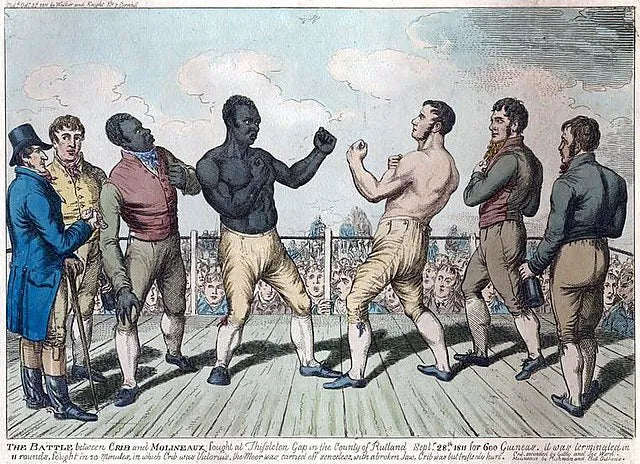
Bill Richmond (1763–1829), known as the Black Terror, was the first Black prizefighter to gain major recognition in Regency England. Born into slavery in Staten Island, New York, he was freed as a teenager and taken to England. There, he was educated and apprenticed, but it was through boxing that he left a revolutionary legacy.

Richmond’s fighting style was striking for its ingenuity. Known as “boxing on the retreat,” his approach relied on movement, evasion and counter-punching rather than brute force. He avoided direct confrontation and used footwork and timing to outmanoeuvre stronger opponents. This contrasted with the prevailing English style of fighting, where boxers often stood toe to toe, exchanging heavy blows until one fell.
Richmond’s tactical methods allowed him to win even when he was smaller or less physically imposing.
Some historians, such as T. J. Desch Obi (2009), argue that Richmond’s methods may reflect African and diasporic combat traditions, particularly from Angola. These traditions emphasised evasion, angles and indirect defence. Combined with the bare-knuckle boxing culture of Georgian England, these elements produced a distinctive and intelligent style. Richmond’s approach set him apart and influenced later fighters who valued skill, rhythm and movement as much as power.

Richmond’s record confirms his skill and innovation. He won around seventeen of nineteen known fights, losing only twice. His opponents included Jack Holmes, George Maddox and Tom Cribb, the English champion. Even in defeat, Richmond’s performances were admired for their grace and intellect. His 1809 victory over Maddox remains notable for his clever retreating strategy, which demonstrated both discipline and psychological insight.
Outside the ring, Richmond was equally remarkable. He owned a public house near Leicester Square called the Horse and Dolphin. The inn was more than a business; it became a hub for London’s boxing community. Richmond organised sparring exhibitions there and was known for several innovations that shaped the sport. He was the first to spar without a vest or shirt, a practice that later became standard. He also devised the idea of a raised stage for matches so that spectators could see more of the action. This removable stage was used at the Fives Court, which stood next door to his inn, where weekly sparring events took place. Richmond was also active in the Pugilistic Club and was the recipient of its first benefit, receiving £50 for a public demonstration of his gloved sparring abilities.

Richmond’s social life was as extraordinary as his boxing. He mingled with literary and political figures such as Lord Byron, the Duke of Northumberland and other members of Regency society who admired his character and skill. His ability to move between working-class boxing circles and elite society made him a rare and respected figure. He even served as an usher at the coronation of King George IV in 1821, a striking image of a Black man standing at the centre of British ceremony in a period still marked by slavery and racial prejudice.
Richmond’s legacy lies in how he challenged both racial and martial expectations of his time. His career showed that boxing could be more than brute strength. It could be an art that reflected intellect, discipline and self-expression. His life bridged cultures, classes and races, showing that identity could be shaped through courage and mastery rather than circumstance. This history holds valuable lessons for us today. Learning about pioneers like Richmond shows that sport carries deep cultural meaning. His story demonstrates that discipline, creativity and psychological strategy can define success as much as power or aggression. The boxing ring can therefore become a space of identity, resilience and social change.
References
Desch Obi, T. J. (2009). Black Terror: Bill Richmond’s Revolutionary Boxing. Journal of Sport History, 36(1), 99–114. University of Illinois Press.
Black History Month UK. (2015). Bill Richmond the pioneering pugilist. Black History Month UK.
Sky Sports. (2020). Bill Richmond (1763–1829): Bare knuckle king of the prize fight ring. Sky Sports.
Stezano, M. (2017). The 19th Century Black Sports Superstar You’ve Never Heard Of. History.com
,%20known%20as%20the%20Black%20Terror,%20was%20the%20first%20Black%20prizefighter%20to%20gain%20major%20recognition%20in%20Regency%20England.%20Born%20into%20slavery%20in%20Staten%20Island,%20New%20York,%20he%20was%20freed%20as%20a%20...)